
Specialist Applications:
Thoracic surgery
TenaTac® reduced persistent
air leaks in a clinical study
TenaTac® significantly reduced post-operative air leakage duration vs. standard of care in a French study that analysed 60 consecutive patients undergoing robotic-assisted pulmonary lobectomy. The mean length of hospital stay for the TenaTac® group was also reduced by 36 hours vs. the control group.
This study was also a poster presentation at the 6th International Joint Meeting on Thoracic Surgery in Barcelona, 2024 (see article here)
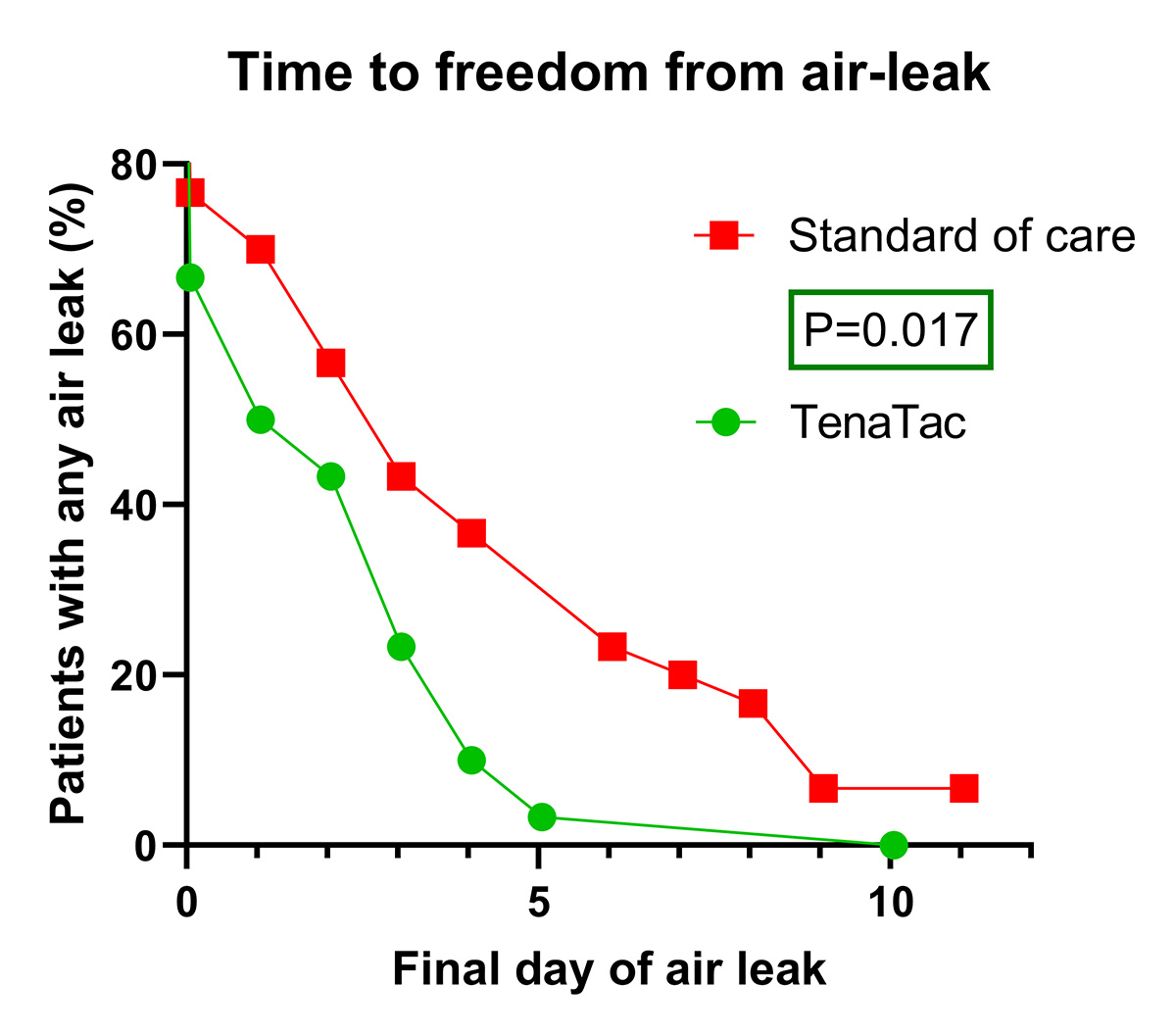
The chest drains in the TenaTac® group were removed significantly earlier than the standard of care group (4.9 v 6.5 days, p=0.04)
TenaTac® is flexible, elastic and conforms to tissue contours
After contact with bodily fluids and further compression with saline-moistened gauze, the patch will change into a gel-like material and can be used to cover the staple line in a lung resection.
Case Study:
Formation of an adhesive, elastic hydrogel

1.
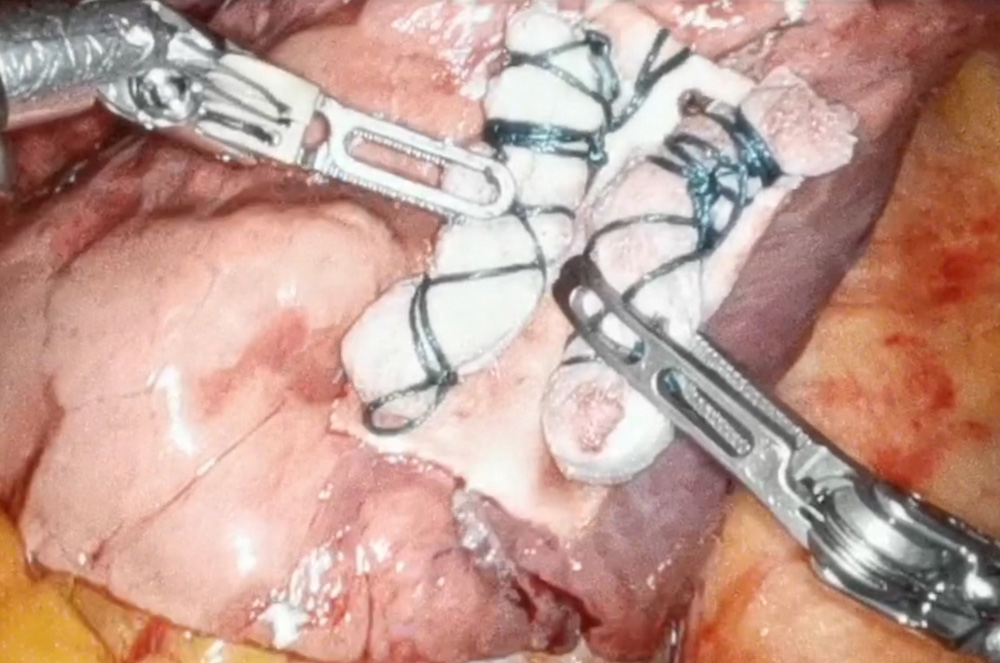
TenaTac® is initially applied DRY along the staple line or on the source of the air leak and then compressed into place with moistened gauze tampons.
Note: Any water immersion testing should be completed before using TenaTac. The lung should be partially inflated prior to applying TenaTac.
2.
The tampons are then moistened again with saline and gently pressed on the product to moisten it further

3.
This causes TenaTac® to transition from a white patch to a gel-like layer that covers the staple line and is adhesive and highly elastic.
